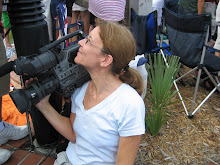
I'm not sure what to think about Berlinger's fight to suppress raw footage collected for his film Crude. Apparently, the Netflix online streaming version of Crude contained footage of Equadoran lawyers strategizing that the DVD version does not. Chevron's attorneys want to see all of that footage because they think it will help their case.
The journalist in me wants to defend his first amendment right to protect his "notes," which in the case of a documentarian, means raw footage. At the same time, I believe documentaries should reveal "truth." So, if the online version of the film shows the Ecuadoran lawyers making mistakes... and that's a more truthful version of the story than the DVD which does not contain the lawyer footage... what does that say about the manipulation of footage to create instead a less accurate "version" of the truth?
My sympathy, of course, is with the indigenous people of Ecuador who have clearly been screwed by Chevron. Further, the court's decision to force Berlinger to release his raw footage takes us down the slippery slope that could ultimately harm the protected sources of any journalist.
I guess I wish Berlinger had been more careful. Find the premise of your documentary, select the material that supports your premise, then stick with it. What bothers me most is one version of the truth online, and another on DVD. I'm afraid this damages the credibilty of his argument. I wonder what Michael Rabiger would say.
Monday, June 7, 2010

The downside of technology
This article about multi-tasking is worth reading all the way to the end without any interruptions from your cell phone, Facebook or email.
http://www.nytimes.com/2010/06/07/technology/07brain.html
http://www.nytimes.com/2010/06/07/technology/07brain.html
Friday, June 4, 2010
Doc Consultants
I've noticed quite a few "documentary consulting companies" popping up in links to sites I browse. Here's one of the latest: http://newdocediting.com/land/ultimate_documentary_guide/
People should just read Michael Rabiger's book. It only costs $50.
People should just read Michael Rabiger's book. It only costs $50.
Wednesday, May 26, 2010
Documentaries by subject
This is a great link for those looking for other docs already done on their topic: http://documentaries.about.com/od/populardocsubjects/u/PopularSubjects.htm
Monday, May 17, 2010
Documentary Articles
Here is a good site for articles about docs with some links at the bottom for trailers and doc distribution companies. This comes from Mark Freeman, head of the documentary working group for the University Film and Video Association.
http://documentaries.about.com/od/documentarydirectors/a/
http://documentaries.about.com/od/documentarydirectors/a/
Wednesday, May 12, 2010
Free Docs Online
I've entered YCC in Amsterdam's International Documentary Film Festival, which is in November. While exploring their Web site I discovered they have an online TV Channel with free docs like this one about Haiti:
Tuesday, May 11, 2010
Spring Success
Whew! It has been a busy spring! I've had a blast screening The Young Composers Challenge at the Florida Film Festival and picking up the "best long form doc" award at BEA. Now the wait continues to see what other festivals may accept the film. I'm especially interested in a new festival in Park City, Utah that features "films about music." We shall see. I've also entered the film in another academic competition. The University Film and Video Association will have its national conference at Champlain College in Vermont in August.
I've also finished a new short film with my Honors Documentary Workshop class. Dr. Robert Cassanello from the History Department is the co-director and producer of this film about the only married couple slain together for their work in civil rights. Aaron Hose did a masterful job in editing the film, and you can watch it on his Vimeo site: http://vimeo.com/11268452 This film screened at the Harry and Harriette Moore Festival in Mims, Florida back in mid April. We will be submitting this to the Global Peace Film Festival. I was pleased that UCF President John Hitt watched the film online and sent me a nice note about it.
This summer I intend to get to work on a new short, The Circle Closes and finish my feature, Wally's Way to the Moon. I'll also be taking my Foundations of Story large lecture course up on the Web so that it will be offered fully online this coming fall. Looks like a busy summer!
I've also finished a new short film with my Honors Documentary Workshop class. Dr. Robert Cassanello from the History Department is the co-director and producer of this film about the only married couple slain together for their work in civil rights. Aaron Hose did a masterful job in editing the film, and you can watch it on his Vimeo site: http://vimeo.com/11268452 This film screened at the Harry and Harriette Moore Festival in Mims, Florida back in mid April. We will be submitting this to the Global Peace Film Festival. I was pleased that UCF President John Hitt watched the film online and sent me a nice note about it.
This summer I intend to get to work on a new short, The Circle Closes and finish my feature, Wally's Way to the Moon. I'll also be taking my Foundations of Story large lecture course up on the Web so that it will be offered fully online this coming fall. Looks like a busy summer!
Subscribe to:
Posts (Atom)